Current Projects

Now Gathering Stories of Courageous Moral Leaders …
My current book project, Courageous Moral Leadership from Common People, is evolving as I research, speak, and visit various faith communities and other organizations.
Many scholars, journalists, and politicians argue that the current moral leadership vacuum in the U.S. poses a threat to democracy and erodes the nation’s trust in public policies, other institutions, organizations, and each other. The moral leadership vacuum fuels cynicism, and cynicism in turn breeds distrust.
Social psychologists have been studying the growth of collective cynicism over the last fifty years, particularly toward educational institutions, the government, and the media. Cynicism spreads and deepens as inequalities grow within and between countries. Deepening inequalities socially, economically, and politically in an environment of perceived scarcity can lock people into “a zero-sum mindset” where they feel like they have to get whatever they can.
This book invites readers to focus their attention on the formation and guiding values of common people who change our lives every day. I began collecting stories of common people who live by their values and create an alternative ethos in the summer of 2025, and I will continue this work of gathering stories through upcoming speaking engagements scheduled during in Roanoke (VA), Durham and Boone (NC), and other places in the spring and fall of 2027.
Each of these stories will help to identify the values of courageous moral leadership that we need to embody today. Sample stories include the following:
Manolo Betancur opened his bakery in Charlotte, North Carolina, nearly thirty years ago. Betancur closed his bakery in the fall of 2025 after witnessing Border Patrol stop and aggressively arrest people on Central Avenue, a main thoroughfare in the city. He told reporters, “I saw how they threw those people down on the street … they didn’t even ask them what their status was … I’m not going to risk my customers. Safety is more important than any money, any profits, or any economic system.” This baker emerged as an incredible moral leader in the city as he witnessed belonging, accompaniment, and justice. Manolo’s bakery became a hub of protest and advocacy for several weeks.
When the Rev. Bev Cosby inherited his family home in Lynchburg, Virginia, he decided to dedicate it to sharing and created the Church of the Covenant and Camp Kum Ba Yah. You may recognize his name as the brother of Gordon Cosby, one of the co-founders of Church of the Savior in Washington, DC. As the Church of the Covenant evolved, Cosby founded other ministries, including the Lodge of the Fisherman and the Gateway. Prayer and contemplation were at the center of Cosby’s daily practice.
Aunt Fleta and Uncle Ossie Marsh never achieved any kind of local or national notoriety. During the Great Depression, my grandmother could not afford to support my father and his brother, Gene. Aunt Fleta and Uncle Ossie created space in their home in St. Louis and then on the small farm they built in Cuba, Missouri. They were what Wendell Berry calls “stickers.” They loved the homes they made and the people within and around them. They resisted the ethics of the dominant culture and the impulse of boomers to seek control and power over others, to “pillage and run,” and “end up on easy street.”
These three stories offer three examples, and I intend to include many more. Please reach out to me at ehinsonhasty@upsem.edu to share your story or the story of another courageous moral leader whom I might include in the book.
Recent Interview Projects
During 2019, I began interviewing siblings growing up in families affected by serious mental illness that informed my bookDutiful Love. This book was published and released in August of 2021. You can find it on Amazon.com or order it directly from Fortress Press as well as other websites.
What was this project about?
Dutiful Love and Mental Health addresses a major contemporary U.S. problem neglected by scholars of theology and religious leaders within congregations and fill a significant gap in the literature focusing on the intersection of theology, disability studies, and mental illness.
There were four main goals to the project:
• to share stories about how mental illness impacts a larger family system, particularly siblings;
• to discuss and analyze Christian ideas informing care for people with mental illness within a larger family system;
• to draw upon empirical data and examine the context for care in the US and explore how the financial and caregiving burden is placed upon individual families;
• and, to develop a constructive and liberating theological response to mental illness from a progressive feminist theological perspective.
Many thanks to the Louisville Institute for their support for this project.
Video Projects
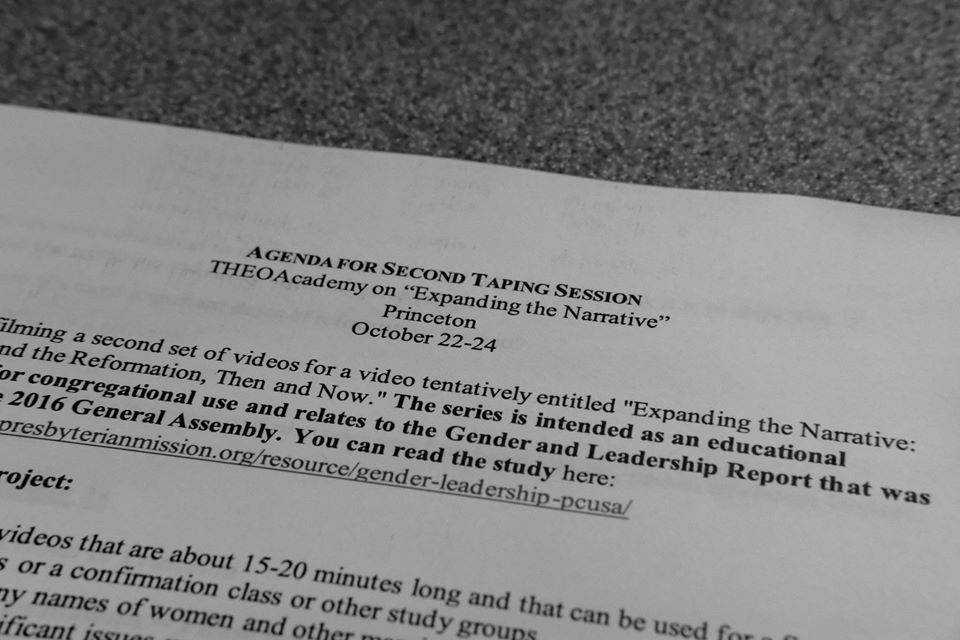
I produced a video series in collaboration with Theocademy and Racial Equity and Women’s Intercultural Ministries of the PCUSA intended to provide new educational resources for study in the PCUSA and other denominations. The series entitled “Expanding the Narrative: Women and the Reformation” discusses women, gender, movements for reform, and a variety of contextual theologies and is intended to foster honest dialogue regarding gender discrimination and biases within the Reformed theological tradition. This series emerged out of a larger research project assessing the status of women on all levels of the PCUSA that incorporated both a sociological study, resulting in the Gender and Leadership Report (2016), and a theological consultation (held at McCormick Theological Seminary in 2016).
You can find the video series by following this link: http://www.theocademy.com/expanding-the-narrative-women-and-the-reformation
 Creating Cultural Shifts